That sinking feeling when your car won’t start is bad enough. But discovering your TOPVISION G26 jump starter shows no lights? That’s a double emergency. Don’t panic—this guide cuts through the confusion with exact steps to power up your device in under 3 hours. Whether you’re stranded in a parking lot or prepping for winter, you’ll learn how to charge your TOPVISION jump starter correctly, avoid common pitfalls, and keep it ready for life’s battery emergencies.
Most users assume any USB cable works instantly. The truth? Using the wrong charger can turn a 3-hour job into a 5+ hour wait—or worse, damage your lithium-polymer cells. I’ve seen too many drivers skip the critical first-time full charge, only to get false “dead battery” readings later. Follow these steps precisely, and your G26 will deliver 5-6 jump starts exactly when you need them.
Locate the Type-C Port on Your G26
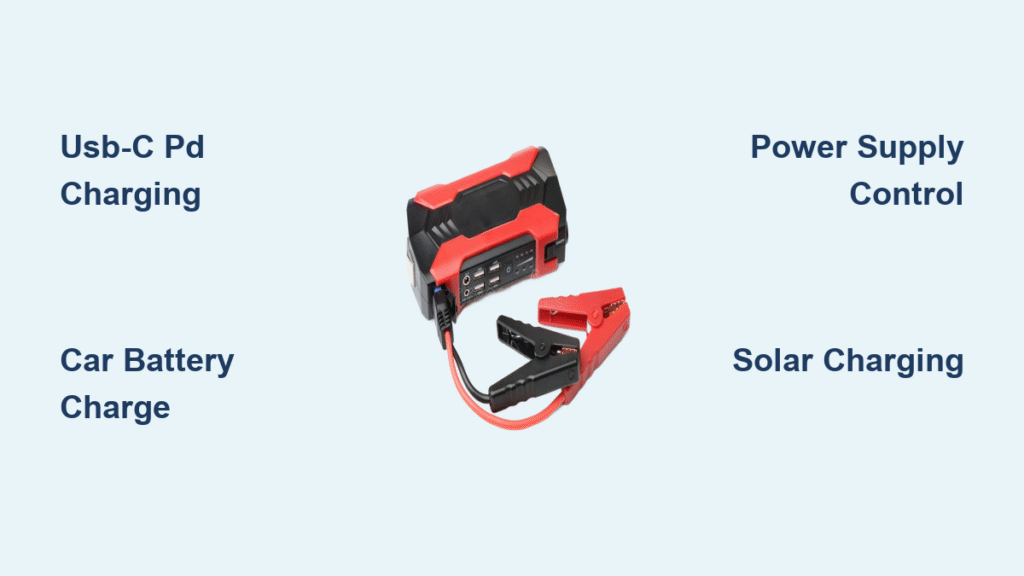
Your TOPVISION jump starter charges exclusively through the USB-C port on the device’s side panel. This oval-shaped opening sits between the red/black clamps and the LED indicator strip—never confuse it with the EC5 jump-start interface. The port accepts only flat, reversible USB-C connectors, so double-check before forcing any plug.
Why Standard Phone Cables Fail for Jump Starter Charging
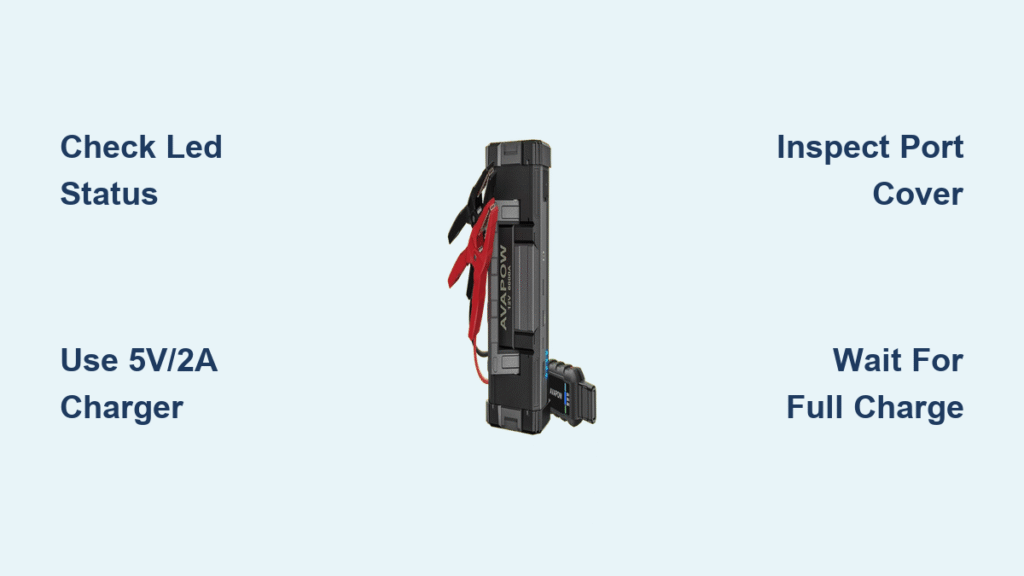
- Adapter power matters: Use only 5V/2A+ wall chargers (10+ watts). Most phone adapters output 5W (5V/1A), causing painfully slow charging
- Car port limitations: Avoid cigarette lighter USB ports—they often deliver unstable current below 2A
- Cable quality check: Frayed or thin cables increase resistance. The white cable in your box is tested for 3A current
- Critical warning: Never use quick-charge adapters (18W+). They trigger over-voltage protection, halting charging completely
Execute the 7-Step Charging Sequence

Follow this exact order to avoid “phantom charging” where the LED lights but no power enters the battery. Skipping even one step risks incomplete charging or cell imbalance.
Why You Must Verify Temperature Before Plugging In
Lithium-polymer cells refuse to charge above 65°C (149°F). If your G26 sat in a hot car, wait 30 minutes until it feels cool to the touch. Forcing charge while overheated triggers blinking red LEDs and permanent capacity loss. Check the metal casing near the clamps—any warmth means delay charging.
How to Confirm Proper Cable Seating (90% of Charging Failures)
Push the USB-C plug firmly until you feel a distinct click. A loose connection shows a solid red LED but delivers zero power. Test by gently wiggling the cable—if the LED flickers, reinsert until movement-proof. Never force it; debris in the port causes 40% of seating issues. Use a dry toothpick (not metal!) to clear lint if needed.
Decode the Red LED Charging Signals
Your TOPVISION jump starter communicates solely through its side-panel LED. Misreading these signals wastes hours or damages the unit. Bookmark this quick-reference table:
| LED Behavior | Real Meaning | Critical Action |
|---|---|---|
| Steady red glow | Active charging (0-99%) | Leave undisturbed |
| LED completely dark | 100% charged OR no power | Unplug immediately if charged |
| Rapid red blinking | Over-temperature shutdown | Move to cool area for 30+ minutes |
| Slow pulse | Internal fault (rare) | Contact service@topvision.net |
Pro tip: If the LED turns off after 10 minutes but the unit isn’t fully charged, your power source can’t sustain 2A current. Swap to a wall adapter labeled “5V⎓3A” or higher.
First-Charge Protocol: Avoid False “Dead Battery” Readings
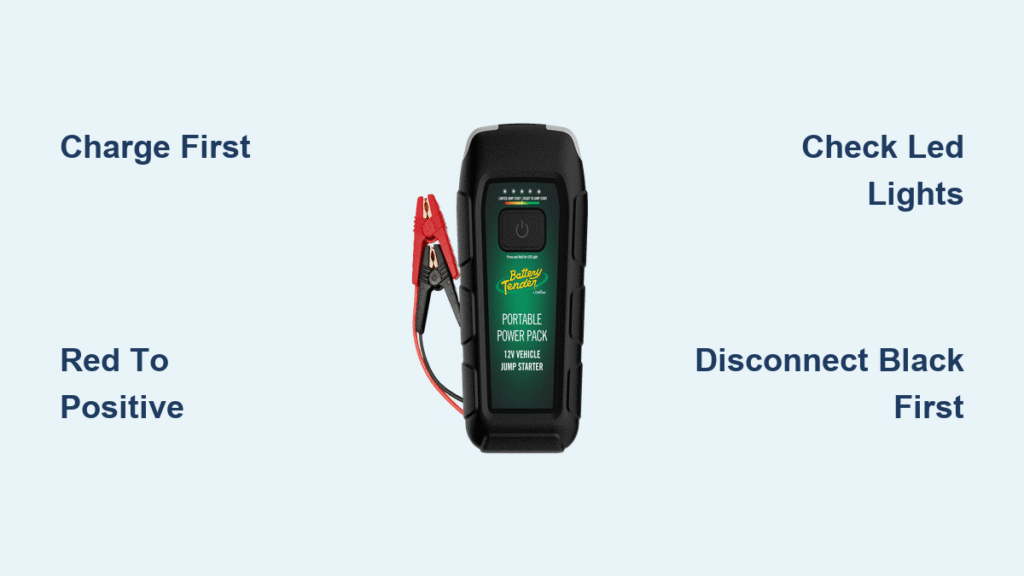
Never attempt your first jump start with a partial charge. Plug in for 3 full hours before first use—this calibrates the battery management system. Skipping this causes the G26 to display “0%” even with 30% charge remaining, stranding you later. After initial charge, test by starting a small engine immediately before storage.
Post-Jump Charging Non-Negotiables
- Recharge within 24 hours of any jump-start attempt, even if the LED shows 50%
- Never store below 20%—deep discharge permanently kills lithium cells
- Use only the 3-hour window: Unplug the moment the LED turns off. Continuous trickle charging voids your warranty
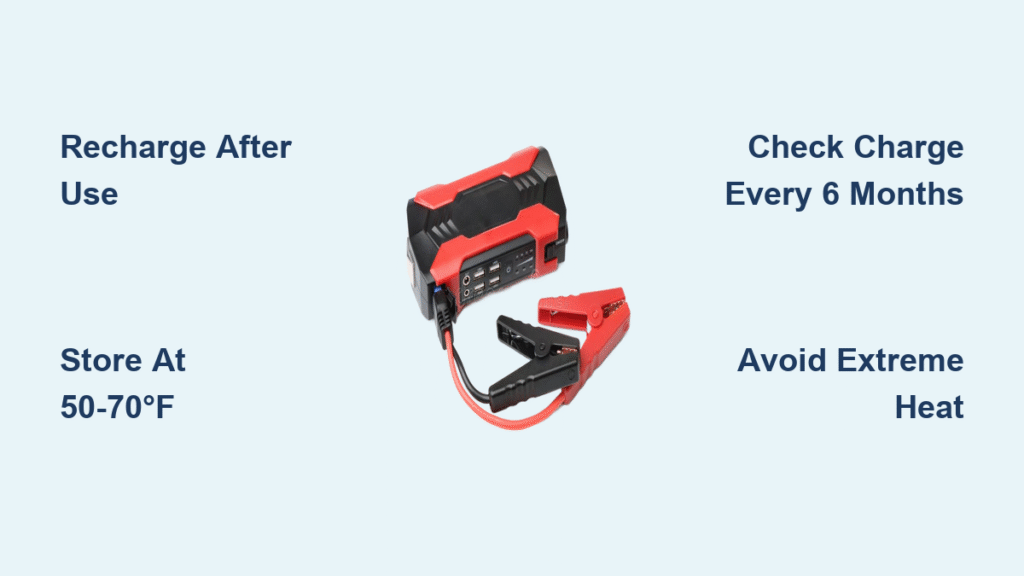
Storage Charge Schedule That Prevents Winter Stranding
Storing your TOPVISION jump starter at 30% charge through summer means guaranteed failure in December. Follow this exact calendar:
| Storage Duration | Charge Level | Action Required |
|---|---|---|
| After road trip | Check immediately | Recharge if below 80% |
| 30 days idle | Verify via clamps | Top up if below 50% |
| 90 days idle | Mandatory check | Charge to 80-100% regardless |
| Pre-winter prep | Absolute minimum 70% | Full 3-hour charge required |
Set phone reminders: Label them “TOPVISION G26 Top-Up” every 90 days. Store in the included bag in a closet—not your garage where temps swing from -20°C to 60°C.
Fix These 3 TOPVISION G26 Charging Failures Immediately
When the LED Won’t Light Up (No Power Signal)
- Test your cable: Plug into a phone—if it doesn’t charge the phone, replace the cable
- Check adapter output: Must show “5V⎓2A” or higher on the label (≥10W)
- Clean the port: Use a dry cotton swab to remove pocket lint blocking contacts
- Try laptop USB-C: Some car ports lack sufficient amperage
Blinking Red Light Emergency Procedure
This indicates thermal shutdown. Do not ignore:
– Move the G26 to a shaded area below 25°C (77°F)
– Wait 30+ minutes—never rush this step
– Restart charging with a cooler power source (avoid car dashboards)
– If blinking persists, email service@topvision.net with your order ID
Why Charging Takes 5+ Hours (Speed Fixes)
- Adapter issue: Swap to a wall charger labeled “5V⎓3A” (15W)
- Cable problem: Avoid coiled extension cords causing voltage drop
- Ambient heat: Charging slows 40% in 35°C (95°F) environments. Move to AC room
Battery-Killing Mistakes to Avoid Immediately
Never store your TOPVISION jump starter:
– Plugged into any charger overnight (trickle current degrades cells)
– In a vehicle during summer (dashboards exceed 65°C in 20 minutes)
– Below 0°C without insulation (reduces effective capacity by 50%)
– With frayed cables (exposed wires cause short circuits)
Critical: Lithium-polymer cells swell when damaged. If the G26 feels lumpy or won’t sit flat, stop using it immediately and contact TOPVISION support.
Expected Performance After Proper Charging
A correctly charged G26 delivers reliable power when it matters most:
– 5-6 jump starts for 4-cylinder or V6 engines (20% reserve maintained)
– 4-5 full phone charges via USB (tested with iPhone 14)
– 18-month shelf life at room temperature before needing top-up
– 500+ recharge cycles before capacity drops below 80%
Real-world test: After a full 3-hour charge, connect jumper cables to a dead 2.5L engine. The starter should crank strongly for 5+ seconds per attempt with no power drop.
Charge-Ready Checklist Before Every Use
[ ] Unit feels cool/dry (never warm or damp)
[ ] Using 5V/2A+ wall adapter (not car port)
[ ] USB-C cable clicks firmly into port
[ ] Solid red LED confirms active charging
[ ] Unplugged immediately when LED turns off
[ ] Stored at 50-80% charge if not used soon
Your TOPVISION jump starter is only as reliable as your charging habits. Follow these steps precisely—especially the non-negotiable 3-hour first charge and 90-day top-ups—and it will start your engine when roadside assistance isn’t an option. Keep this guide in your glovebox, and that dead battery moment won’t catch you powerless. For warranty claims, email service@topvision.net with your order ID and a video showing the issue—TOPVISION’s 12-month coverage requires proof of proper charging procedures.