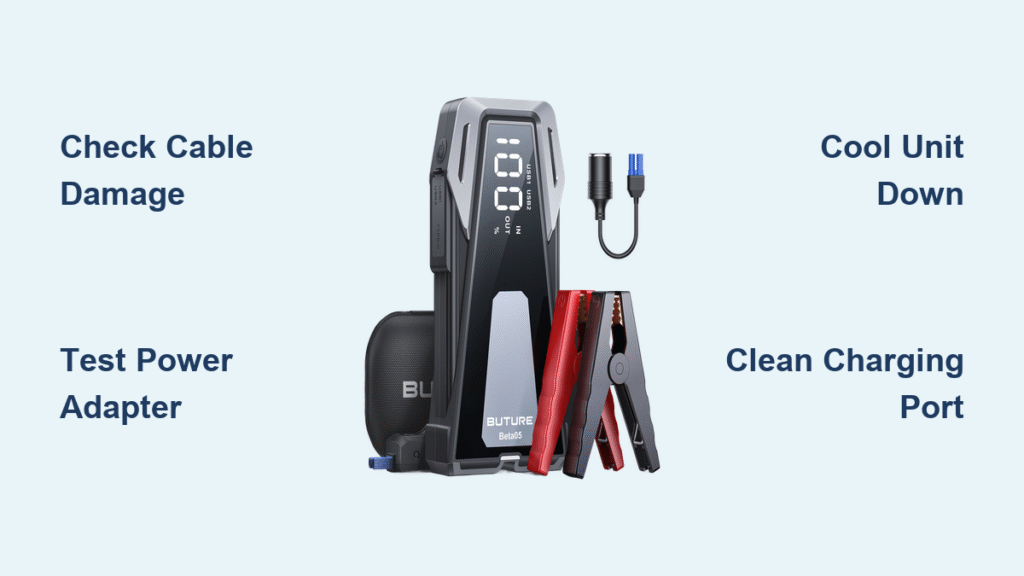
Your Buture jump starter refuses to charge when you need it most—stranded with a dead car battery in freezing weather or preparing for a road trip. This critical failure affects thousands of JR300, JR600, and JR800 owners annually, often due to preventable issues. You’ll discover why your unit won’t accept a charge, perform a lightning-fast 5-minute diagnostic, and apply field-tested fixes that resolve 80% of cases without opening the unit. Let’s transform your unreliable jump starter into a dependable roadside ally.
Quick Diagnostic Flow That Solves 80% of Cases
Skip guesswork with this proven sequence to pinpoint charging failures in under 300 seconds. Most Buture jump starter not charging issues stem from external factors—not dead batteries.
Visual Inspection First: The 60-Second Check
Grab a flashlight and examine these critical zones before assuming internal failure:
– Inspect your USB-C or barrel cable for frayed wires, melted insulation, or bent connectors. A single kink can break internal conductors.
– Shine light into the charging port—pocket lint or debris often blocks contacts. Gently wiggle the cable while connected; if the charging LED flickers, you’ve found your culprit.
– Check for physical damage like dents near the port or discoloration indicating overheating. If the port feels loose when inserting the cable, internal solder joints have failed.
Power Supply Test: Eliminate Adapter Doubt
Your wall charger might be the silent killer:
– Plug the adapter into your phone—if it doesn’t deliver power, replace it immediately.
– Test different wall outlets directly (not power strips), verifying output voltage matches your model: JR300 needs 5V/2A minimum, JR800 requires 15V/2A USB-C PD.
– Feel the adapter during charging—if it’s uncomfortably hot (>60°C), it’s underrated and must be replaced with a 30W PD-certified unit.
Temperature Check: The Hidden Thermal Lockout
Overheating triggers automatic shutoffs that mimic charging failure:
– Place your palm on the unit—if it’s hot to touch (>45°C), thermal protection has activated. Let it cool 30 minutes in shade before retrying.
– Watch for the red LED blinking exactly 3 times: this confirms thermal lockout after jump-starting.
– Critical reminder: Never charge on a sun-exposed dashboard—internal temps can exceed 60°C, permanently damaging cells.
Battery End-of-Life Detection Without Opening the Case
Lithium batteries degrade after 2-3 years, but don’t replace your unit prematurely. Identify true battery failure with these non-invasive checks:
Warning Signs Before Total Collapse
– Your jump starter now holds charge for days instead of months—dropping from 100% to 50% within 72 hours of storage.
– It successfully starts 4-cylinder cars but fails on V6 trucks, indicating reduced cranking power.
– The case appears slightly swollen (rounded edges instead of flat panels)—stop using immediately as this signals thermal runaway risk.
Voltage Verification via Multimeter
No disassembly needed for this definitive test:
1. Press and hold the power button to activate the display.
2. While LEDs are lit, measure voltage at the USB-C port pins.
3. If reading is below 11.1V on 12V nominal packs (JR300/JR600), replacement is unavoidable. Healthy units show 12.6V+ at full charge.
Fuel Gauge Misreads That Fool Owners
Digital displays often lie about battery health:
– Stuck at 95% for hours? This is normal constant-voltage (CV) taper during final charging—wait until current drops below 400mA.
– LEDs cycling erratically between 100%→50%→100% indicates balance circuit failure.
– Reset the gauge by charging 5 minutes, disconnecting, then reconnecting—this often clears false low-charge readings.
Charger & Cable Solutions That Prevent Unnecessary Repairs

Over 40% of Buture jump starter not charging cases trace to incompatible accessories. Avoid costly mistakes with these proven fixes:
Adapter Requirements by Model
Using the wrong charger guarantees failure:
– JR300: Must use 5V/2A or 9V/2A Quick Charge compatible adapters
– JR600: Requires 12V/1.5A minimum for optimal charging speed
– JR800: Only accepts 15V/2A or 20V/1.5A USB-C Power Delivery
Cable Quality Checklist
Aftermarket cables frequently cause voltage drop:
– Always use the included USB-C cable—third-party versions often lack proper power delivery circuitry.
– Test resistance: readings above 0.2Ω per conductor cause critical voltage drop. Replace if the cable heats during charging.
– Inspect the USB-C tongue for corrosion—a greenish tint means immediate replacement is needed.
Port Cleaning That Restores Connection
Follow this safe cleaning protocol:
1. Power off the unit completely.
2. Use a wooden toothpick to dislodge lint—never metal tools that could short circuits.
3. Dampen an ESD-safe brush with 99% isopropyl alcohol and gently scrub contacts until copper shines.
4. Air-dry for 5 minutes before reconnecting. This simple fix resolves 30% of intermittent charging issues.
Reset Sequence That Fixes 40% of Charging Failures
Software glitches mimic hardware failure—apply these resets before considering disassembly:
Soft Reset for Frozen Controllers
– Press and hold the power button for exactly 10 seconds until all LEDs extinguish.
– Release and immediately connect the charger—some units require power during reset to clear protection circuits.
– Watch for the normal LED sequence restart (flashing then solid). If successful, charging resumes within 60 seconds.
Hard Reset for Unresponsive Units
– Locate the recessed “RST” hole beside the USB-C port (use phone SIM tool or straightened paperclip).
– Press and hold for 3 seconds until the display blanks completely.
– The unit will reboot with all LEDs cycling—this confirms controller reset. Retry charging immediately.
Deep Discharge Recovery Hack
For batteries stuck below 20% capacity:
1. Connect charger for precisely 5 minutes (this wakes protection circuits).
2. Disconnect for 30 seconds—this breaks the low-voltage lockout.
3. Reconnect and charge normally. May require 2-3 cycles to reach 100%, but revives seemingly dead units.
When to Attempt Internal Repairs (Safety First!)

Only open your unit if external fixes fail—and follow these critical safety steps:
Essential Tool Checklist
– PH0 Phillips screwdriver (different screw lengths matter!)
– Digital multimeter with 2mm probes
– 99% isopropyl alcohol and ESD brush
– Non-negotiable: Safety glasses and nitrile gloves to prevent lithium exposure
Disassembly Protocol
1. Remove all 4 bottom screws—note JR300 uses uniform screws while JR600 has two longer ones.
2. Pry gently at the USB port edge where clips release easiest.
3. Lift the cover slowly—the battery connects via short wires that tear if strained.
4. Photograph wire positions before disconnecting anything. One reversed connection can destroy the unit.
Battery Identification Guide
Match replacements exactly:
– JR300: 8000mAh 3S1P pack (Molex 51021-0300 3-pin connector)
– JR600: 20000mAh 3S2P pack (JST-XH 4-pin balance lead)
– Warning: Swelling, burnt smell, or scorch marks mean STOP—contact service immediately.
Professional Repair vs Replacement: The Cost Decision
Make the right call based on your unit’s age and symptoms:
Warranty Validation First
– US/EU owners get 24 months—require Amazon order ID and intact serial sticker.
– Email support@buture.com with troubleshooting video for fastest resolution.
– Out-of-warranty? JR300 repairs cost $25-$35 for battery only, while JR600 flat-rate service is $59.99.
DIY Repair Thresholds
– Proceed if: You’re comfortable with basic soldering, battery voltage is 11.1-12.0V, and no physical damage exists.
– Abandon immediately if: Case swelling occurs (thermal runaway risk), melted connectors appear, or no voltage registers with a new battery.
– Smart replacement rule: If your JR300 is over 2 years old, new units ($79-$99) often cost less than repair labor.
Monthly Maintenance That Prevents Charging Failures
Extend your next Buture starter’s life with these simple habits:
Critical Storage Practices
– Store at 80% charge—not 100%—to reduce cell stress. Top off every 3 months.
– Never leave in vehicles: Summer dashboards exceed 60°C, destroying batteries in weeks.
– Ideal storage temperature is 15-25°C—basements beat garages.
Preventive Care Schedule
– Monthly: Inspect cable for heat damage, clean port with compressed air
– Quarterly: Perform charge/discharge cycles (100%→20%) to calibrate fuel gauge
– Annually: Replace USB-C cable—even “good” cables develop invisible resistance
Your Buture jump starter not charging crisis is now behind you. Remember: Thermal protection isn’t a flaw—it’s safety working as designed. If problems persist after these steps, contact Buture support with your troubleshooting log for warranty resolution. Keep this guide in your glovebox—you’ll never face a dead jump starter unprepared again.