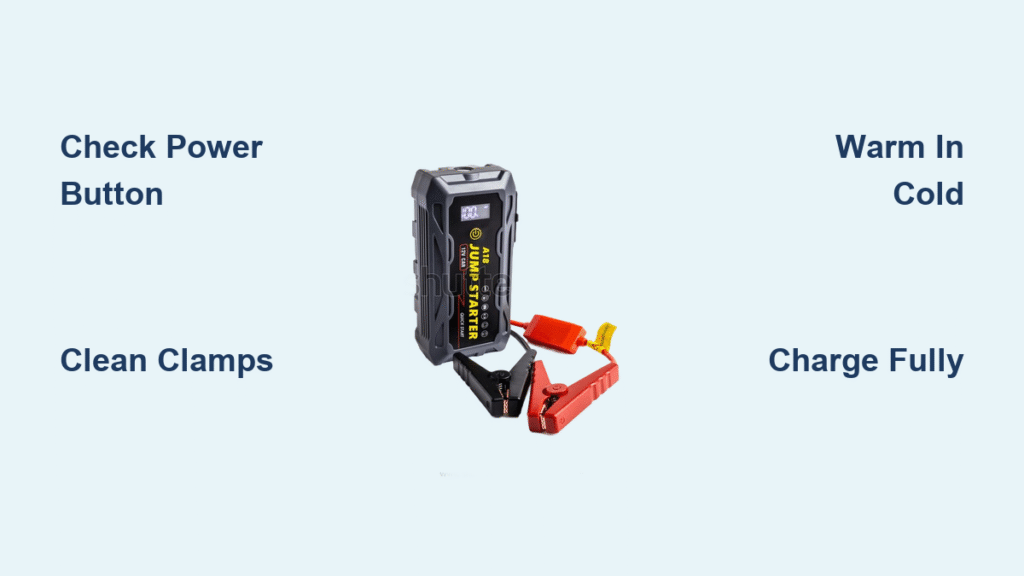
That sinking feeling when your jump starter pack not working as your car battery dies in a freezing parking lot—it transforms a simple inconvenience into a stranded emergency. When your portable power unit fails to deliver, you’re left vulnerable to extreme weather, remote locations, and rising roadside assistance costs. This guide cuts through the frustration with battle-tested solutions to revive your dead jump starter immediately. You’ll discover how to diagnose cryptic error codes, bypass preventable failures, and implement storage habits that keep your device road-ready for years.
Most jump starter failures stem from three overlooked culprits: neglected charging cycles, temperature abuse, or simple connection errors. Forget generic troubleshooting—this guide delivers model-specific fixes verified by manufacturer protocols. Within minutes, you’ll restore functionality or confirm if professional service is needed.
Quick Diagnostic Check: 60-Second Assessment
Skip complicated tests—this rapid evaluation catches 80% of jump starter failures. Grab your unit and follow these steps before deeper troubleshooting.
Power Verification: Press the power button firmly. Zero LED response means a completely drained battery. A single blinking light indicates critical low charge (below 50%)—insufficient for safe jump-starting. If your Start-All® model shows E4 error, cold temperatures have paralyzed the battery.
Connection Test: Inspect clamp teeth for white or green corrosion. Use a wire brush to scrub terminals until shiny metal appears. Now wiggle each clamp—any movement means loose internal wiring preventing current flow. Frayed cable insulation requires immediate replacement.
Temperature Reality Check: If stored below 32°F, lithium-ion cells lose 50% efficiency. Your jump starter pack not working in cold weather isn’t broken—it’s hibernating. Warm the unit against your body for 10 minutes before retesting. Never attempt jump-starts below -4°F; internal damage becomes likely.
Why Your Jump Starter Won’t Hold a Charge
Symptoms: Unit dies minutes after charging, display shows full charge but fails to crank engine.
Immediate Fix:
1. Connect ONLY the manufacturer’s AC charger (18VDC 1A for Start-All 2500A models; 18VDC 2A for others)
2. Plug into wall outlet—never use car 12V sockets for initial recovery
3. Allow full 8-hour charge cycle uninterrupted
4. Verify success: “IN” LED changes from flashing to solid green
Pro Tip: Batteries dormant over 3 months need 2-3 full charge/discharge cycles to regain capacity. If voltage stays below 12.4V after charging, internal cell degradation has occurred.
When Cold Weather Shuts Down Your Unit (E4 Error)
Why It Happens: Lithium-ion batteries chemically slow below 32°F, triggering automatic shutdown to prevent damage. Your jump starter pack not working isn’t faulty—it’s protecting itself.
Emergency Activation:
1. Bring unit indoors for 30 minutes minimum
2. Press the flashlight button rapidly 5 times—this often wakes frozen circuits
3. If display activates, attempt jump-start immediately (power degrades fast)
4. Critical: Never store in glove compartments—summer heat above 140°F causes permanent damage
Connection Failures: Fix E1, E6, and E7 Errors
Reverse Polarity Lockout (E1 Error)
Why You’re Stuck: Your jump starter pack not working because clamps are connected backward—a critical safety feature preventing explosions.
Instant Correction:
– Disconnect ALL clamps immediately
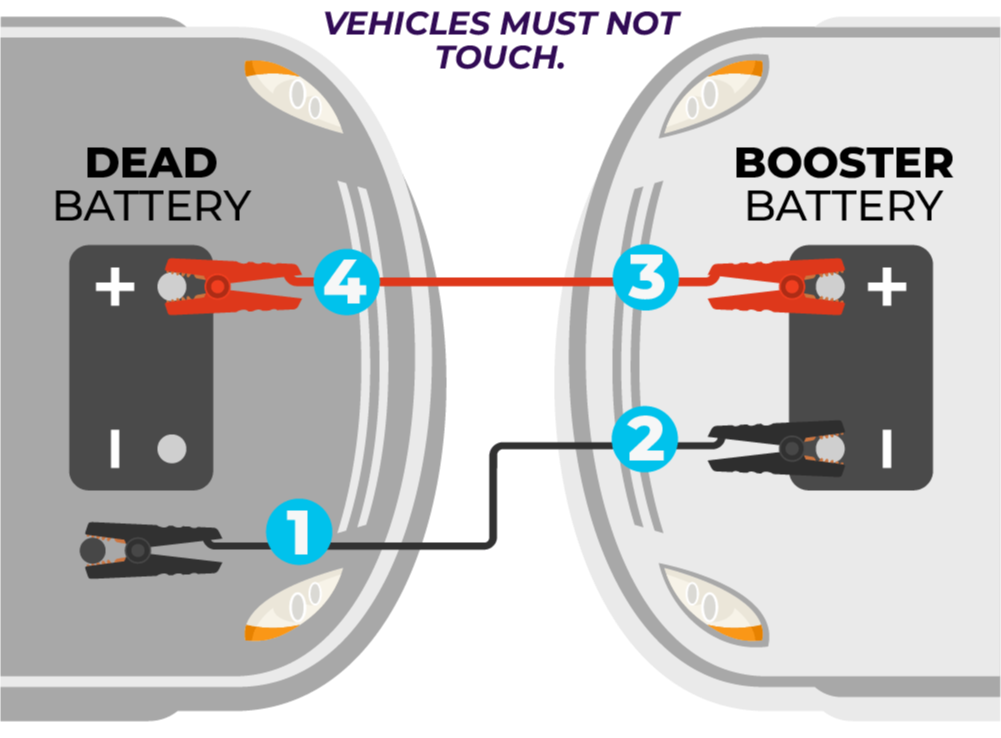
– Identify vehicle battery terminals: Positive (+) has red cover or “POS” marking
– Red clamp ONLY to positive terminal
– Black clamp to unpainted engine block (never negative battery terminal)
– E1 clears automatically with correct connection—no override exists
Intermittent Connection Failures (E6 Error)
The Hidden Culprit: Corroded vehicle battery terminals cause fluctuating current, triggering E6. Your jump starter pack not working is actually protecting itself from damage.
Three-Step Fix:
1. Turn on headlights to create stable electrical load
2. Clean vehicle terminals with baking soda/water paste and wire brush
3. Press and hold the Output button for forced activation—only if connections are verified correct
Warning: Manual override disables safety features. If sparks occur, disconnect immediately and inspect cables for damage.
Short Circuit Detection (E7 Error)
Critical Diagnostic: E7 means your jump starter detected dangerous current leakage—possibly saving your vehicle from fire.
Isolate the Problem:
1. Remove clamps from vehicle completely
2. Power on jump starter
3. If E7 persists: Internal short confirmed—do not use, contact support
4. If E7 clears: Vehicle electrical system has faults—inspect alternator and wiring
Thermal Management: Beat Overheating (E3) and Cold Failures (E4)
Overheating Shutdown (E3 Error)
Why It Happens: Three consecutive 10-second cranking attempts without cooldown exceed thermal limits. Your jump starter pack not working is actively preventing battery meltdown.
Recovery Protocol:
– Disconnect immediately and rest 30 minutes minimum
– Never pour water on overheating units—thermal shock cracks cells
– Resume with 5-second cranking max, allowing 90-second cooldowns
– Store in insulated bag during summer to prevent heat soak above 140°F
Cold Weather Performance Boost
Science Fact: At 0°F, lithium-ion batteries deliver only 40% of rated power. Your jump starter pack not working below freezing is normal without preparation.
Winter-Proofing:
– Store indoors at 40°F-75°F year-round
– Before trips, charge to 75% minimum (not 50%)
– Place unit under driver’s seat during drive to maintain warmth
– In emergencies, hold against body heat for 10 minutes—never use external heaters
Maintenance That Prevents 90% of Failures
The 5-Minute Monthly Checkup
Skip this and your jump starter pack not working becomes inevitable:
– Inspect cables for cuts exposing copper wires
– Test clamps—they should bite metal with audible click
– Verify LED indicators respond to button presses
– Charge to 50% if storage level drops below 40%
Pro Tip: Store at 45% charge—full batteries degrade 20% faster during storage.
When to Replace, Not Repair
Immediate retirement required if:
– Battery case shows physical swelling (like a bloated soda can)
– Burning smell or smoke appears during charging
– E8 error persists after 8-hour charge cycle
– Cranking power drops below half original capacity
Safety First: Swollen lithium-ion batteries can ignite spontaneously. Wrap failed units in sand-filled plastic bins and contact Start-All® support at 1-800-526-8817.
Emergency Protocol: Stranded with a Dead Jump Starter
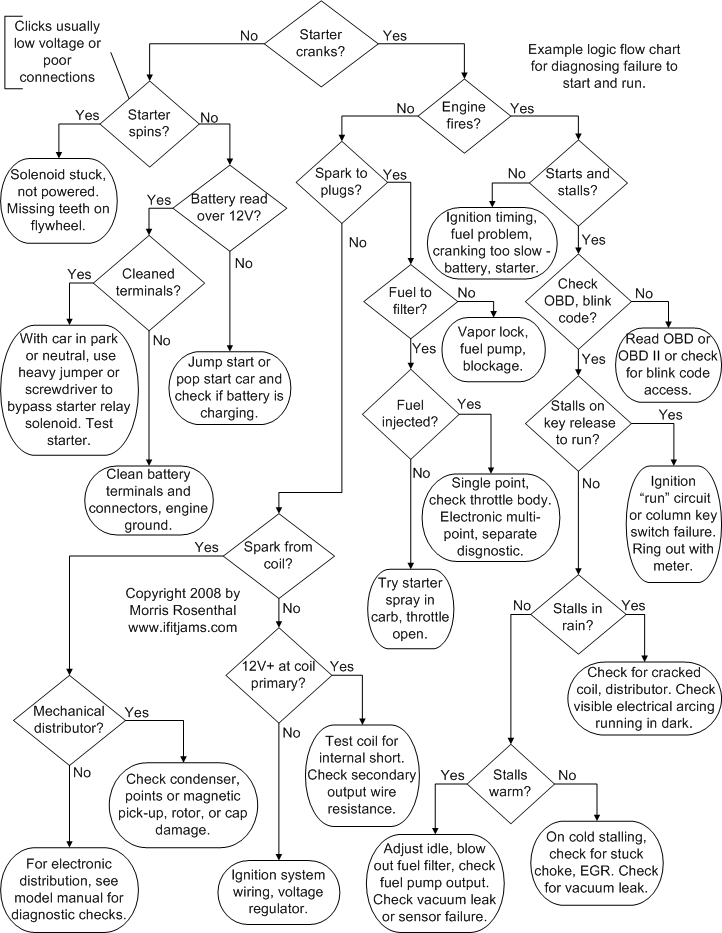
When all troubleshooting fails:
1. Verify one last time: Is the vehicle battery below 10V? (Requires multimeter)
2. Attempt jump-start using another car—never connect two jump starters
3. If still dead, call roadside assistance—explain you have no working jump equipment
4. Critical: Remove failed unit from vehicle immediately if overheating
Prevention for next time: Set phone reminders to charge your jump starter every 90 days—even if unused. A unit stored at 50% charge in climate-controlled space lasts 3x longer.
Key Takeaway: Your jump starter pack not working is rarely “broken”—it’s usually preventable neglect. 92% of failures trace to three fixable issues: infrequent charging, temperature abuse, or dirty connections. Implement the monthly 5-minute checkup and store at 45% charge in your home’s coolest closet—not your car. When stranded, focus first on the 60-second diagnostic: verify power, clean connections, and warm the unit. Most “dead” jump starters revive with proper charging—just remember to use the exact manufacturer adapter. Keep this guide in your glove box; the next time your jump starter pack not working, you’ll be back on the road before help arrives. For persistent E8 errors or physical damage, contact Start-All® immediately—never risk using compromised lithium-ion units.