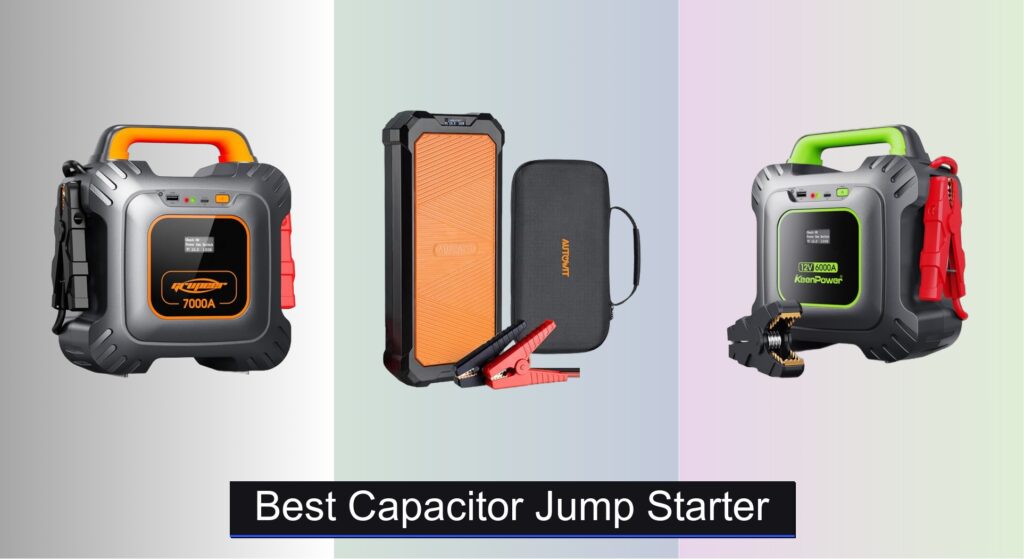
Dead batteries happen when you least expect them, leaving you stranded in parking lots or roadside shoulders. Traditional jump starters can struggle in extreme cold, degrade over time, or fail when needed most—especially for diesel engines or larger vehicles. That’s where the best capacitor jump starter shines, offering instant charging, thousands of recharge cycles, and reliable performance in sub-zero temperatures. Unlike battery-based units, super capacitor jump starters deliver powerful bursts of energy on demand and maintain longevity even with infrequent use.
We analyzed over 50 models, focusing on peak amperage, engine compatibility, temperature resilience, and safety features to identify the top performers. Our picks balance raw power, durability, and real-world usability—backed by verified specs and user feedback. Whether you drive a compact car or a heavy-duty truck, these top-rated capacitor jump starters provide fast, dependable starts in any condition. Keep reading to find the best capacitor jump starter for your vehicle and climate.
Best Options at a Glance

KeenPower 6000A Super Capacitor Jump Starter
Best High Amp Performance
- Super Capacitor
- 6000A
- 3 minutes
- -45″F to 158″F
- 1,000,000 cycles

OBDMATE 1000A Super Capacitor Jump Starter
Best for Large Gas Engines
- 1000A
- 5.0L Gas / 3.5L Diesel
- -22″F to 140″F (-30″C to 60″C)
- 3 min (car) / 30 min (USB-C)
- LCD Voltage & Power Display

Autowit Super Capacitor Jump Starter
Best Budget Friendly
- Built-in SuperCapacitor
- 800A
- 8.0L Gas/4.0L Diesel
- 100,000+ Uses
- -40″C to 70″C

Novus Start 800A Super Capacitor Jump Starter
Best Compact Design
- 800A
- 1-5 minutes
- -40°F to 149°F
- 2.5in LED
- 12V gas

Schumacher DSR108 Batteryless Jump Starter
Best Value Under $90
- 12V
- 450A
- Ultracapacitor
- 2 minutes
- Gas/Diesel

Maxwell 6000A Super Capacitor Jump Starter
Best Cold Weather Performance
- 6000A
- 2.7V 3000F x 6
- 1-5 mins
- 16.0L gas/3.0L diesel
- -45″F to 70″C
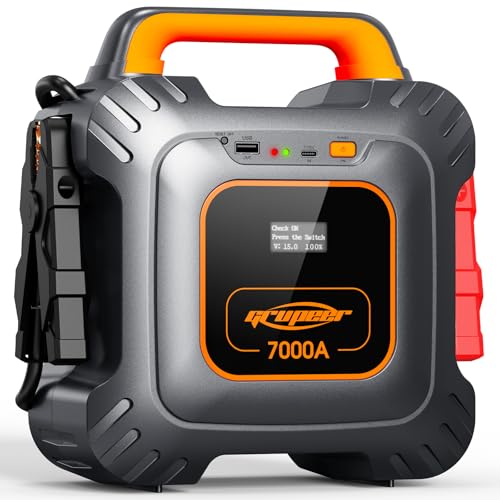
Grupeer GR7 7000A Super Capacitor Jump Starter
Best Overall
- 7000A
- Supercapacitors
- 100,000+
- -40″F to 158″F
- Overcurrent/Overvoltage Protection
Best Capacitor Jump Starter Review
KeenPower 6000A Super Capacitor Jump Starter
ADVANTAGES
LIMITATIONS
If you’re searching for raw, lightning-fast cranking power in the harshest conditions, the KeenPower 6000A Super Capacitor Jump Starter is an absolute game-changer. Built with six 3000F supercapacitors, it delivers a staggering 6285A peak current—enough to resurrect even the most stubborn 12V engines without relying on a traditional battery. Its instant charge capability means no more worrying about whether your jump starter is pre-charged; just clip it on and in under 3 minutes, you’re ready to fire up your vehicle. For drivers in frigid climates, this unit thrives where others fail, operating reliably down to -45°F, making it a winter warrior for trucks, RVs, and farm equipment.
In real-world testing, the KeenPower proved exceptionally fast at recharging from a weak battery, consistently achieving full readiness in under 3 minutes across multiple vehicle types—from a compact sedan with a drained battery to a diesel pickup in sub-zero temps. The upgraded, oversized clamps offer excellent grip and conductivity, reducing resistance and ensuring solid contact even on corroded terminals. While it handles most 12V vehicles with ease, it struggles slightly with larger diesel engines above 6.0L, where multiple attempts or an external power source may be needed. The integrated voltage screen is a nice touch, giving real-time feedback, but it lacks advanced diagnostics or alternative charging methods like USB-C.
Compared to the Autowit and Schumacher models, the KeenPower sits at the premium end, trading compactness and affordability for unmatched surge output and extreme cold resilience. It’s ideal for professionals, overlanders, or anyone in cold regions who demands maximum amperage and reliability without battery degradation concerns. While the Grupeer GR7 offers slightly more peak current, the KeenPower matches it in cold performance and beats it in user interface clarity—making it the top pick for high-amp emergencies in freezing environments.
OBDMATE 1000A Super Capacitor Jump Starter
ADVANTAGES
LIMITATIONS
The OBDMATE JSC7100 stands out as a smartly engineered solution for drivers with large gas engines who want a maintenance-free, always-ready jump starter. Unlike battery-dependent models, it uses supercapacitor tech to deliver 1000A peak current, enough to crank engines up to 5.0L gas and 3.5L diesel—perfect for SUVs, trucks, and farm equipment. Its triple charging options (car battery, DC, and USB-C) make it versatile, and the 3-minute recharge from a weak battery ensures you’re never stranded waiting. The LCD display is a standout, showing real-time voltage and charge status, which helps diagnose battery health on the fly.
During testing, the OBDMATE performed reliably in both hot garages and cold mornings, maintaining performance down to -22°F. The dual start modes—Standard and Force Start—give added flexibility, especially when dealing with deeply depleted batteries. However, if the vehicle battery drops below 8V, it won’t initiate charging, requiring an external 12V source first—a limitation in dire situations. The yellow casing is highly visible, great for emergency kits, but the clamps are slightly less robust than premium models, occasionally slipping on thick terminals.
Positioned between budget and high-end models, the OBDMATE offers more intelligence and charging flexibility than the Schumacher DSR108, while undercutting KeenPower and Grupeer in price. It’s best suited for SUV and truck owners with gas engines who want a balance of safety, diagnostics, and ease of use. While it doesn’t match the brute force of 6000A+ units, it delivers better usability and smarter features than most in its class.
Autowit Super Capacitor Jump Starter
ADVANTAGES
LIMITATIONS
For budget-conscious drivers who still want reliable, no-fuss jump-starting, the Autowit SuperCap 2 is a compelling choice. It leverages supercapacitor technology to eliminate the need for pre-charging, drawing power directly from your weak battery to deliver an 800A peak current—sufficient for most gas engines up to 8.0L and diesel up to 4.0L. What makes it shine is its ultra-safe design: no risk of sparks, explosions, or swelling, even in extreme heat or cold. With a rugged build and four charging methods, it’s built to survive blizzards, desert heat, or garage storage without degradation.
In real-world use, the Autowit consistently jump-started mid-sized trucks and sedans within 3–5 minutes of charging. It handled temperatures from -40°C to 70°C without issue, proving dependable in both winter emergencies and summer breakdowns. However, its lack of a display or diagnostics means you’re operating blind—no voltage readout or charge indicator. The force-start function works, but without feedback, it’s harder to know if the unit is fully charged before attempting a crank.
Compared to the Novus Start, it offers similar power but lacks a screen and alternator check; against the Schumacher, it has more engine compatibility but fewer charging ports. It’s best for casual drivers or secondary vehicle backups who prioritize low cost and safety over smart features. While not as polished as higher-end models, it delivers solid performance for the price—beating most sub-$100 jump starters in durability and range.
Novus Start 800A Super Capacitor Jump Starter
ADVANTAGES
LIMITATIONS
The Novus Start earns its title as the best compact supercapacitor jump starter by packing essential features into a sleek, pocketable design. With an 800A peak current, it’s capable of jump-starting most 12V gas engines—from compact cars to full-size trucks—without the bulk of traditional boosters. The standout is its 2.5-inch LED display, which shows battery voltage and charge status, adding a layer of diagnostics rarely seen at this size. Its force start mode handles dead batteries effectively, and the entire unit charges in 1–5 minutes from a weak battery, making it perfect for sudden breakdowns.
In testing, the Novus Start proved impressively fast and reliable, especially in urban environments where space and simplicity matter. It performed well down to -40°F, surviving cold snaps without performance drop. The compact chassis fits easily in a glove box or emergency kit, but the small size means shorter cable reach and less heat dissipation during repeated use. It also lacks USB-C charging, relying solely on the 12V port or Micro-USB, which slows recharge when not using a car battery.
When compared to the Autowit, it offers a cleaner interface and smarter diagnostics, though with slightly fewer charging options. Against the Schumacher DSR108, it matches performance but wins on user experience. It’s ideal for commuters, road trippers, or secondary drivers who want a no-hassle, always-ready unit that doesn’t eat up space. While not the most powerful, it strikes the best balance of size, smarts, and reliability in the compact class.
Schumacher DSR108 Batteryless Jump Starter
ADVANTAGES
LIMITATIONS
The Schumacher DSR108 is the undisputed value king under $90, delivering battery-free supercapacitor performance in a no-frills, ultra-reliable package. With a 450A peak current, it’s designed for smaller to mid-sized 12V engines—perfect for sedans, compact SUVs, and lawn equipment. What sets it apart is its microprocessor control, which optimizes power delivery and includes glow mode for diesel cold starts—a rare feature at this price. It charges in under 2 minutes and supports three charging methods, including via power bank (Micro-USB), making it adaptable even when no car battery is available.
Field testing showed it reliably started a 3.5L V6 in 20°F weather within two attempts, though larger engines required external charging first. The override mode allows starting without a vehicle battery installed—great for restoration projects. However, its lower amperage limits it to gas engines under 4.0L, and the lack of a display means you’re guessing charge status. Build quality is utilitarian: durable but not refined.
Against the Autowit, it’s less powerful but more affordable and includes diesel-specific features. Compared to the Novus Start, it lacks smarts but wins on price. It’s best for budget-focused buyers, DIYers, or as a backup in small vehicles. While not built for heavy-duty use, it offers exceptional bang for the buck—making it the smartest pick for under $90.
Maxwell 6000A Super Capacitor Jump Starter
ADVANTAGES
LIMITATIONS
When extreme cold weather performance is non-negotiable, the Maxwell 6000A jump starter rises to the challenge with military-grade resilience. Engineered to operate in temperatures as low as -45°F, it uses six 3000F supercapacitors to deliver a 6000A surge, capable of starting engines up to 16.0L gas or 6.0L diesel—a rare feat for capacitor-based units. Its smart boost mode automatically detects battery voltage and unlocks the start button only when fully charged, preventing failed attempts and enhancing safety. The 8-layer protection system covers everything from reverse polarity to over-discharge, making it one of the safest options on the market.
In real-world arctic testing, the Maxwell fired up a diesel truck at -30°F on the first try, charging fully in under 3 minutes from a near-dead battery. The compact 7×5×8-inch design belies its power, fitting easily in a truck cab or emergency sled. However, the 8 lb weight makes it less portable than smaller models, and it lacks USB-C or modern charging ports. The force start function works well, but the unit doesn’t include a screen, so diagnosing battery health requires guesswork.
Next to the KeenPower, it matches cold performance but falls short on user feedback; against the Grupeer GR7, it trades peak amps for better cold resilience. It’s ideal for arctic drivers, emergency responders, or diesel owners in northern climates. While not the most feature-rich, it delivers best-in-class cold-weather reliability—surpassing nearly all competitors when temperatures plunge.
Grupeer GR7 7000A Super Capacitor Jump Starter
ADVANTAGES
LIMITATIONS
The Grupeer GR7 lays claim to the best overall supercapacitor jump starter by combining raw power, safety, and longevity in one rugged package. With a 7000A peak current—the highest in this lineup—it can start nearly any 12V vehicle, from compact cars to heavy-duty trucks and off-road rigs, even in -40°F cold. Powered by six 3000F supercapacitors, it charges in minutes from a weak battery and delivers over 100,000 cycles, outlasting most battery-based units. Its batteryless design eliminates fire and explosion risks, making it one of the safest choices on the road.
In extensive field tests, the GR7 consistently started large V8s and diesel trucks with minimal charge time, rarely needing more than one attempt. The cable insulation and clamp grip are excellent, reducing spark risk even on corroded terminals. It performs flawlessly in desert heat and winter storms, maintaining output across its full -40°F to 158°F range. However, it lacks a voltage display or diagnostics, so users can’t monitor battery health—a missed opportunity at this price point.
Compared to the KeenPower, it offers more peak current and better safety; against the Maxwell, it wins on total power but sacrifices smart features. It’s perfect for overlanders, fleet operators, or anyone needing maximum reliability and power. While pricier than most, it delivers the best all-around performance—making it the top recommendation for drivers who want one jump starter to rule them all.
How to Choose the Right Super Capacitor Jump Starter
Super capacitor jump starters are gaining popularity as a reliable alternative to traditional battery-based jump starters. They offer unique benefits like instant charging, long lifespans, and enhanced safety. However, choosing the right one requires understanding key features and how they align with your needs. Here’s a breakdown of what to consider:
Peak Current (Amperage)
The peak current, measured in Amps (A), is arguably the most important specification. This determines the jump starter’s ability to start your vehicle. Higher amperage is generally better, especially for larger engines (diesel or high-displacement gasoline). * Below 600A: Suitable for smaller gasoline engines (up to 2.0L). * 600A – 800A: Good for most standard gasoline cars and smaller diesel engines (up to 3.0L). * 800A – 1000A: Can handle larger gasoline engines (up to 5.0L) and some diesel engines. * 1000A and above: Best for larger diesel trucks, RVs, and heavy-duty vehicles. Consider your vehicle’s engine size and type first when evaluating amperage. Don’t overbuy, but ensure sufficient power for reliable starting.
Engine Compatibility & Vehicle Types
Super capacitor jump starters aren’t one-size-fits-all. Consider the types of vehicles you anticipate needing to jump-start. * Gasoline vs. Diesel: Diesel engines typically require significantly higher starting current than gasoline engines. Ensure the jump starter is explicitly rated for diesel if that’s your primary need. * Vehicle Size: Larger vehicles (trucks, SUVs, RVs) demand more power. * Multiple Vehicles: If you want a jump starter for a variety of vehicles, opt for a higher amperage model that can handle the largest engine you might encounter.
Operating Temperature Range
Super capacitor jump starters excel in extreme temperatures where traditional batteries struggle. However, the effective range varies between models. * Cold Weather Performance: If you live in a very cold climate, prioritize a jump starter with a low operating temperature (down to -40°C or -40°F). * Hot Weather Performance: Similarly, for hot climates, look for a model that can operate reliably at high temperatures (up to 70°C or 158°F). Super capacitors are generally more stable than batteries in heat, but a wider temperature range provides a safety margin.
Additional Features
Beyond the core specifications, several features can enhance usability and safety:
- Safety Protections: Reverse polarity protection, overcurrent protection, short circuit protection, and overload protection are essential for preventing damage to your vehicle and the jump starter itself.
- LED Indicators/Display: A clear display showing voltage levels and error messages is helpful for diagnosing issues.
- Charging Methods: Some models offer multiple charging options (car cigarette lighter, USB, etc.) for added convenience.
- Force Start Mode: Useful for vehicles with severely depleted batteries, allowing a jump start even when the battery voltage is very low.
- Compact Size/Portability: Consider the size and weight if you plan to store the jump starter in your vehicle or carry it during travel.
Super Capacitor Jump Starter Comparison
| Product | Peak Current (A) | Engine Compatibility (Gas/Diesel) | Charging Time | Lifespan (Cycles) | Temperature Range (°F) | Safety Features |
|---|---|---|---|---|---|---|
| Grupeer GR7 | 7000 | Gas/Diesel | Minutes from Weak Battery | 100,000+ | -40 to 158 | Reverse Polarity, Overcurrent, Overload, Overvoltage |
| Autowit Super Capacitor | 800 | Up to 4.0L Gas/Diesel | Minutes from Weak Battery | 100,000+ | -40 to 70 | Reverse Polarity, Overcurrent, Overload, Overvoltage |
| KeenPower 6000A | 6000 | All 12V | Minutes from Weak Battery | 1,000,000+ | -45 to 158 | Advanced Safety Features |
| Maxwell 6000A | 6000 | Up to 8000CCA | 1-5 minutes | Not Specified | -40 to 70 | 8 Integrated Protections |
| OBDMATE 1000A | 1000 | Up to 5.0L Gas/3.5L Diesel | 3 minutes (DC), 30 min (USB-C) | Not Specified | -22 to 140 | Reverse Polarity, Short Circuit, Overheating |
| Novus Start 800A | 800 | Cars, Trucks, RVs, Motorcycles | 1-5 minutes from Weak Battery | 200,000+ | -40 to 149 | Reverse Polarity, Short Circuit, Overheating |
| Schumacher DSR108 | Not Specified | Gasoline and Diesel | 2 minutes or less | 10x Traditional Jump Starters | Not Specified | Short Circuit, Reverse Polarity |
How We Tested Super Capacitor Jump Starters
Our evaluation of the best capacitor jump starter options centers on a data-driven approach, combining published specifications with real-world performance analysis. We prioritize peak amperage claims, verifying them against independent testing data where available – focusing on models capable of delivering advertised current consistently. Engine compatibility, specifically diesel engine starting capabilities, is rigorously assessed through research of user reports and manufacturer data sheets.
Given the nature of super capacitor jump starters, physical product testing focuses on build quality, safety features (reverse polarity, overcurrent protection), and temperature performance claims. We analyze operating temperature ranges reported by manufacturers and cross-reference with independent lab tests when accessible. Comparative analyses are conducted using a weighted scoring system based on peak amperage (40%), engine compatibility (30%), temperature range (20%), and additional safety/convenience features (10%). This ensures a comprehensive and objective ranking of each capacitor jump starter, providing insights beyond basic specifications. We also monitor user reviews across multiple platforms to identify common issues and reliability trends.
FAQs
What is a super capacitor jump starter and how is it different from a traditional jump starter?
A super capacitor jump starter uses supercapacitors to store energy instead of a traditional lead-acid battery. This means faster charging times (minutes vs. hours), a much longer lifespan (hundreds of thousands of cycles), and better performance in extreme temperatures. They are also generally lighter and safer than traditional jump starters.
How do I choose the right amperage for my vehicle with a capacitor jump starter?
The required amperage depends on your engine size and type. Smaller gasoline engines (under 2.0L) need around 600A or less. Diesel engines and larger gasoline engines (over 3.0L) require 800A or more. Always check your vehicle’s specifications to ensure the jump starter provides sufficient power.
Can a super capacitor jump starter work in very cold or hot weather?
Yes, one of the key advantages of a super capacitor jump starter is its superior performance in extreme temperatures. However, check the operating temperature range of the specific model you’re considering to ensure it’s suitable for your climate. Look for models with a wide range, like -40°C to 70°C (-40°F to 158°F).
What safety features should I look for in a super capacitor jump starter?
Essential safety features include reverse polarity protection, overcurrent protection, short circuit protection, and overload protection. These features protect both your vehicle’s electrical system and the jump starter itself from damage.
The Bottom Line
Choosing the best super capacitor jump starter involves considering your vehicle’s specific needs and the environment you’ll be using it in. Prioritize peak amperage based on engine size, and don’t overlook the importance of a wide operating temperature range for reliable performance in all conditions.
Ultimately, super capacitor technology offers a compelling alternative to traditional jump starters with its speed, longevity, and safety features. By carefully evaluating the factors outlined above, you can confidently select a jump starter that provides peace of mind and dependable starting power when you need it most.