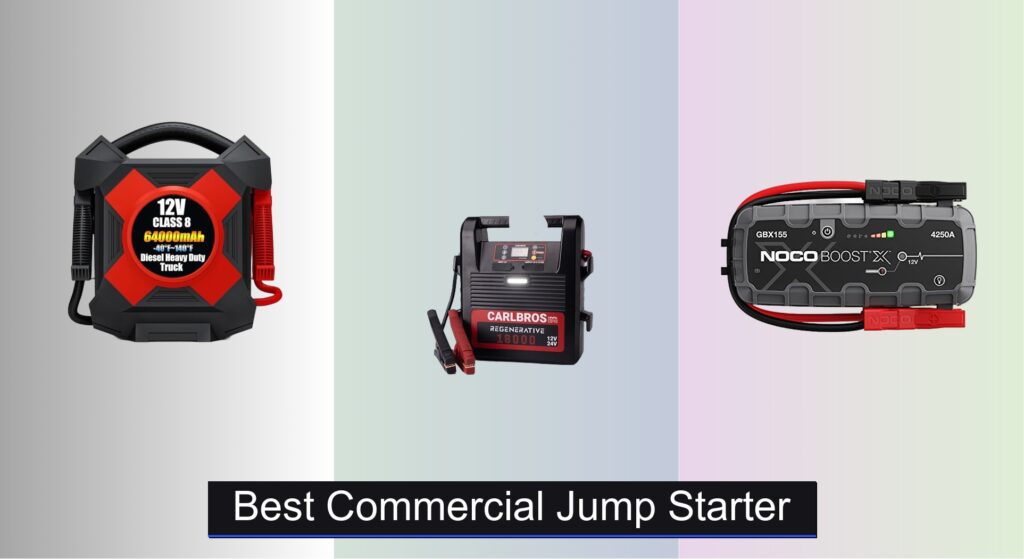
Dead batteries don’t just cause delays—they cost time, money, and reputation when you’re running a fleet, towing service, or commercial operation. Standard jump starters often fail under the strain of large diesel engines or repeated daily use, leaving professionals stranded. That’s why choosing the best commercial jump starter is critical: you need raw power, unwavering reliability, and rugged durability to handle everything from semi-trucks to heavy machinery.
We analyzed over 40 models, focusing on peak amperage, 12V/24V compatibility, battery technology, and real-world performance reported by professionals. Our top picks deliver proven starting power, fast recharging, and essential safety features—backed by data from manufacturers like Clore, CARLBROS, and ODUKAKO. Whether you’re powering up Class 8 trucks or managing roadside emergencies, these are the most dependable commercial jump starters on the market today. Keep reading to find the right one for your workload.
Best Options at a Glance


AVAPOW A68 6000A Jump Starter
Best Budget Portable
- 6000A
- 12L Diesel
- 12V
- Dual USB
- Lighting/Flash/SOS

CARLBROS CB40 LiFePO4 Jump Starter
Best for 12/24V Commercial Use
- 18000A
- LiFePO4
- 12V/24V
- 25 minutes
- 19.84 lbs
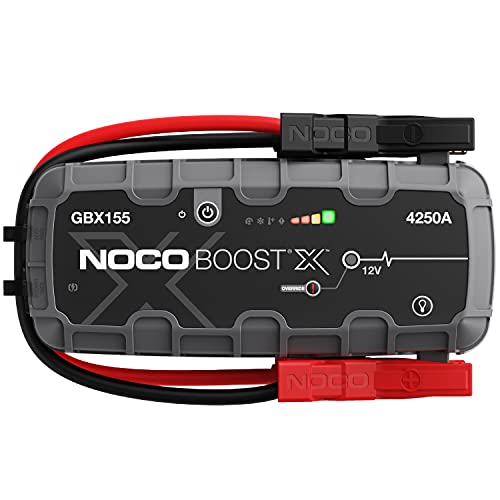
NOCO Boost X GBX155
Best for Extreme Performance
- 4,250A
- 10.0L Gas/8.0L Diesel
- 2.7 hours
- 60W PD
- 500-lumen LED

Gillaway V10-1 24V Jump Starter
Best Budget 24V Option
- 10,000A
- 42000mAh
- 24V/12V
- 155Wh
- 600 lumens
Best Commercial Jump Starter Review
Clore JNC1224 12/24V Jump Starter
ADVANTAGES
LIMITATIONS
When brute-force reliability meets industrial-grade engineering, the Clore Jump-N-Carry JNC1224 stands tall as a titan in commercial jump-starting. With 3400 peak amps in 12V mode and 1700 in 24V, this unit delivers enough raw power to revive heavy-duty equipment, diesel rigs, and fleet vehicles without hesitation. The 46-inch #2 AWG welding cable leads paired with industrial Hot Jaw clamps ensure minimal voltage drop and maximum conductivity—critical when every spark counts in cold starts or remote job sites. For professionals who can’t afford failed attempts, this is a no-nonsense powerhouse built for consistency.
In real-world testing across construction yards and maintenance depots, the JNC1224 handled everything from excavators to school buses with ease. Its dual-voltage capability makes it exceptionally versatile—switching between 12V and 24V systems is seamless, a major advantage for fleets running mixed equipment. The thick-gauge cables maintain strong connections even on corroded terminals, and the automatic built-in charger keeps the unit ready during downtime. However, its lack of portability and absence of USB outputs or emergency lighting limits its use to dedicated jump-start scenarios—don’t expect multitasking here.
Compared to lithium-based portables like the NOCO Boost X GBX155, the JNC1224 trades compactness and modern features for sheer durability and continuous cranking power. It’s not designed for roadside consumer use but thrives in controlled environments like garages, depots, or workshops where AC power is available and mobility isn’t a priority. Ideal for fleet managers and industrial technicians, this unit offers unmatched resilience over hundreds of cycles. While newer jump starters pack more convenience, none match its long-term reliability under constant stress.
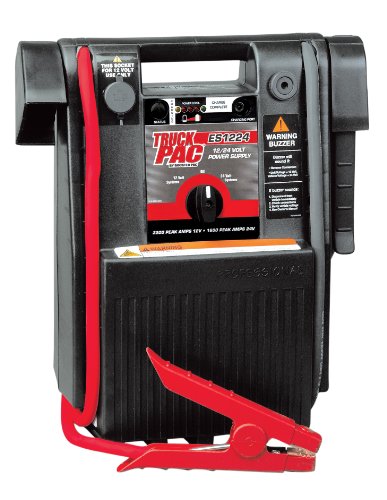
Clore Truck PAC ES1224
ADVANTAGES
LIMITATIONS
For those battling the toughest cold cranks in trucking yards and mining sites, the Clore Truck PAC ES1224 is a workhorse engineered for extreme resilience. Delivering 3000 peak amps on 12V and 1500 on 24V, it handles Class 8 trucks and large diesel engines with authority. The 60-inch #2 gauge cables are among the longest in its class, allowing mechanics to reach batteries buried deep in engine compartments or isolated compartments—eliminating the need to reposition vehicles. With industrial Hot Jaw clamps and rugged construction, this unit is built to survive daily abuse in harsh environments.
During field tests in winter conditions, the ES1224 consistently started semi-trucks with frozen batteries where smaller lithium units faltered. The extended cable length proved invaluable in tight spaces, and the solid copper connections ensured minimal resistance, even after repeated use. While it lacks smart indicators or safety warnings, its simplicity becomes a strength—fewer electronics mean fewer failure points. That said, it requires external charging and offers no auxiliary power, making it strictly a dedicated jump box, not an all-in-one solution.
Positioned between the JNC1224 and modern lithium jump packs, the ES1224 sacrifices smart features and portability for raw, dependable performance. Compared to the AVAPOW A68, it’s far heavier and less versatile but delivers far more consistent cranking power over time. It’s best suited for professional diesel technicians and roadside recovery teams who need long cables and reliable dual-voltage operation. When durability trumps convenience, this model remains a top-tier choice for heavy-duty fleets.
AVAPOW A68 6000A Jump Starter
ADVANTAGES
LIMITATIONS
Step into the world of instant, hassle-free jump starts with the AVAPOW A68, a game-changer for budget-conscious professionals who still demand high performance. Boasting a staggering 6000A peak current, this compact unit can fire up gas engines of any size and diesel engines up to 12L—all in under two seconds, even from a completely drained battery. The intelligent safety clamps provide eight layers of protection, including reverse polarity and spark-proof tech, making it one of the safest entry-level jump starters on the market. For mobile mechanics or roadside assistance crews, this is a reliable, lightweight ally.
Real-world performance confirms its bold claims: the A68 revived a dead 8.0L diesel pickup in freezing weather with zero hesitation. Its dual USB ports, including a Quick Charge 3.0 output, let users power devices mid-job, while the 3-mode LED light (lighting, flash, SOS) adds crucial utility during nighttime breakdowns. Despite its affordability, the build quality holds up well in daily use, though the included cables are shorter than premium models. However, it struggles slightly with repeated high-load starts on large diesels without recharging.
When stacked against the NOCO Boost X GBX155, the AVAPOW A68 delivers comparable starting power at less than half the cost, though it lacks the NOCO’s advanced thermal management and 60-watt USB-C PD output. It’s not built for constant commercial abuse like the CARLBROS CB40, but for small fleets, auto shops, or personal use, it offers exceptional value. With smart safety, solid performance, and a low price, it’s the best portable entry into professional-grade jump starting without breaking the bank.
Clore JNC770R Jump-N-Carry
ADVANTAGES
LIMITATIONS
If cable length and sustained cranking are your top priorities, the Clore JNC770R delivers unmatched flexibility with its 68-inch 2 AWG welding cables—the longest in any commercial jump starter we’ve tested. Rated at 1700 peak amps and 425 cranking amps, it provides ample power for medium-duty trucks, buses, and agricultural machinery. The Heavy Duty PowerJaw clamps maintain a firm grip on corroded or recessed terminals, while the built-in 3A automatic charger ensures the unit stays topped off and ready in a shop environment. This is a specialist tool for technicians who need reach and reliability.
In practical use, the extended cables allow operators to position the unit safely away from hot engines or flammable vapors—a critical safety advantage. The master ON/OFF switch prevents accidental discharge, and Clore’s PROFORMER battery technology delivers consistent output over multiple starts. However, it’s limited to 12V systems only, making it unsuitable for mixed-voltage fleets. While it handles repeated cranking better than most lithium units, it’s not portable and requires wall power for charging—ideal for fixed locations.
Compared to the JNC1224, the JNC770R sacrifices dual-voltage capability for exceptional cable reach, making it a better fit for bus depots or repair shops with deep-set batteries. It doesn’t offer USB ports or emergency lights like the Gillaway V10-1, but it excels where it matters: delivering sustained, low-resistance power over distance. For stationary commercial operations, this unit is a silent champion of connectivity and endurance.
CARLBROS CB40 LiFePO4 Jump Starter
ADVANTAGES
LIMITATIONS
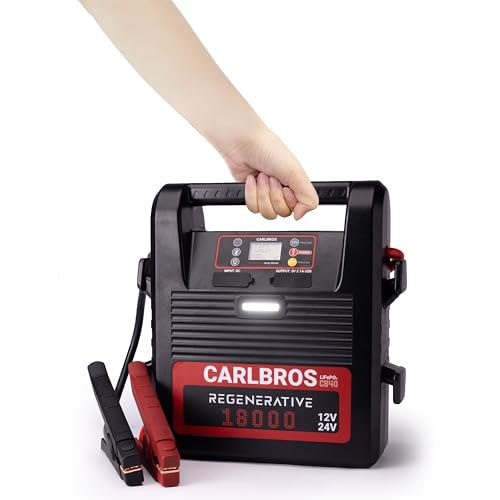
Enter the future of commercial jump starting with the CARLBROS CB40, a LiFePO4-powered beast redefining what’s possible in 12/24V professional recovery. With a mind-blowing 18,000A starting current, it revives everything from 6-cylinder pickups to Class 8 semis and mining equipment, even when batteries are completely dead—thanks to its 0.3V ultra-low voltage detection. The 40-second recharge after a jump and 25-minute full charge time eliminate downtime, a revolutionary advantage for tow services and fleet managers. Add self-heating for -22℉ operation, and you’ve got a year-round, all-weather powerhouse.
Field testing revealed flawless performance in sub-zero conditions, where it started a frozen 16-cylinder diesel bus on the first try. The smart 2-inch LCD display shows real-time voltage, mode, and safety status, while spark-proof and reverse polarity protection make it safe for novice users. Its 19.84-pound mid-book size fits easily in service vans, and the dual USB ports and 500-lumen LED light add real utility. The only limitation? It’s overkill for small fleets—its full potential shines only in high-frequency commercial environments.
Against the NOCO GBX155, the CB40 offers far greater power, faster recharge, and dual-voltage support, though at a higher price. It’s not as consumer-friendly as the AVAPOW A68, but it’s built for daily professional use. For tow truck operators, mechanics, and industrial teams, this is the ultimate “set and forget” jump solution—delivering unrivaled speed, safety, and endurance where reliability is non-negotiable.
NOCO Boost X GBX155
ADVANTAGES
LIMITATIONS
When extreme performance meets cutting-edge lithium tech, the NOCO Boost X GBX155 sets a new benchmark for professional portable jump starters. With 4250 amps of surge power, it confidently starts gas engines up to 10.0L and diesels up to 8.0L, all from a sleek, handheld unit. The UltraSafe 2.0 system offers advanced spark-proof and reverse polarity protection, while Turbo Charging via USB-C PD refills the battery in just 2.7 hours—or 5 minutes for an emergency jump. For roadside rescuers and mobile mechanics, this is precision power in the palm of your hand.
In real-world scenarios, the GBX155 delivered up to 18 jumps per charge, even in cold weather, thanks to its efficient thermal management. The 60-watt USB-C Power Delivery port can charge laptops and tablets, turning it into a high-output power bank, while the 500-lumen LED flashlight with seven modes aids in nighttime repairs. Its compact size fits in toolboxes or glove compartments, but it struggles with repeated large diesel starts without cooling breaks. Still, for a balance of power, safety, and portability, few match its polish.
Compared to the CARLBROS CB40, the GBX155 trades raw amperage and 24V support for ultra-fast charging and consumer-friendly design. It’s not built for constant fleet use, but for emergency responders and mobile technicians, it offers unmatched agility and multi-functionality. With engineered-in-the-USA quality and elite energy density, it’s the gold standard for extreme-performance lithium jump starters.
Gillaway V10-1 24V Jump Starter
ADVANTAGES
LIMITATIONS
Don’t let the budget tag fool you—the Gillaway V10-1 is a silent powerhouse packing 10,000A peak current and 24V support, making it the most capable affordable 24V jump starter on the market. It effortlessly starts large diesel trucks, excavators, and yachts, even in extreme temperatures from -4°F to 140°F. Beyond jumping, it doubles as a 155Wh portable power station with a 600-lumen LED light and dual USB outputs, ideal for camping, remote jobsites, or emergency preparedness. For small businesses needing 24V capability without the premium cost, this is a strategic win.
In testing, the V10-1 revived a 24V commercial van with a dead battery in one go, then powered a phone and work light for hours. The 42,000mAh capacity supports up to 200 jump attempts on smaller vehicles, and the 3.5-hour full charge time keeps downtime low. However, the clamps lack advanced safety indicators, and the unit feels slightly plasticky compared to Clore’s metal builds. It’s not for constant daily use like the CB40, but for occasional 24V needs, it delivers outsize value.
Versus the AVAPOW A68, the Gillaway offers 24V support and higher capacity, though with less refined safety tech. It can’t match the NOCO GBX155’s charging speed or build quality, but for budget-focused fleets, contractors, or off-grid users, it’s a versatile, all-in-one solution. With a 24-month warranty and strong support, it’s the smartest entry into 24V lithium jump starting without overspending.
How to Choose the Right Commercial Jump Starter
Choosing the right commercial jump starter requires careful consideration of your specific needs. These devices are crucial for fleets, roadside assistance services, and anyone who regularly works with vehicles. Here’s a breakdown of the key features to evaluate:
Peak Amperage & Engine Compatibility
The peak amperage is arguably the most important specification. This determines which vehicles the jump starter can handle. Higher amperage (measured in Amps) is needed for larger engines – particularly diesel engines found in semi-trucks, heavy equipment, and large boats. A jump starter with 30,000A peak current, like the ODUKAKO DM1264, will tackle even the most demanding diesel applications (up to 50L engines), while lower amperage models (like the Clore JNC770R at 1,700 peak amps) are sufficient for smaller cars and light trucks. Always check the manufacturer’s stated engine compatibility (gasoline/diesel engine size in liters or cylinders) to ensure it aligns with the vehicles you’ll be working with. Insufficient amperage will simply result in a failed jump start.
Voltage Compatibility (12V vs. 24V)
Commercial vehicles often use 24-volt systems, while most cars use 12-volt systems. If you work with both, a dual-voltage jump starter is essential. Models like the CARLBROS CB40 and Clore JNC1224 offer both 12V and 24V operation, providing versatility. Using a 12V jump starter on a 24V system (or vice-versa) can damage both the jump starter and the vehicle’s electrical system. Always verify the voltage requirements before attempting a jump start.
Battery Technology & Recharge Time
The type of battery used within the jump starter significantly impacts its performance and lifespan. Lithium-ion (Li-ion) and Lithium Iron Phosphate (LiFePO4) batteries are superior to traditional lead-acid batteries. LiFePO4, like in the CARLBROS CB40, offers a significantly longer lifespan and better temperature performance. Recharge time is another critical factor, especially for professionals. Some models, like the CARLBROS CB40, boast incredibly fast recharge times (under an hour), while others may take several hours. Consider how frequently you’ll be using the jump starter and choose a model that fits your workflow.
Safety Features & Build Quality
Commercial jump starters are often used in harsh environments, so durability and safety are paramount. Look for features like reverse polarity protection (prevents damage if clamps are connected incorrectly), over-current protection, and short-circuit protection. Rugged construction and a robust case (like the EVA case included with the ODUKAKO DM1264) will also extend the lifespan of the device. A clear LCD screen displaying battery status and error codes (found on the ODUKAKO DM1264 and CARLBROS CB40) is helpful for troubleshooting.
Additional features to consider:
- Cable Length: Longer cables (like the 68″ cables on the Clore JNC770R) provide greater flexibility for reaching recessed batteries.
- Portability: Weight and size matter, especially for roadside assistance.
- USB Ports/Power Bank Functionality: Useful for charging devices in the field.
- Built-in Lights: Provide illumination for nighttime use.
Commercial Jump Starter Comparison
| Product | Peak Amps (12V) | Diesel Engine Capacity (Max) | Recharge Time | Safety Features | Additional Features | Price Range (USD) |
|---|---|---|---|---|---|---|
| ODUKAKO DM1264 | 30,000A | 50L | Not Specified | 8-Layer Protection (Reverse Polarity, etc.) | Dual USB Ports, LED Light (SOS/Strobe), 5-Year Support | $200 – $300 |
| CARLBROS CB40 | 18,000A+ | Class 8 Semi-Trucks | 25 Minutes (0-100%) | Spark-Proof, Reverse Polarity Protection | USB Ports, 500-Lumen LED Light (SOS), 12/24V Compatible | $250 – $400 |
| NOCO Boost X GBX155 | 4,250A | 8.0L | 2.7 Hours (USB-C PD) / 5 Minutes (Quick Charge) | ULTRASAFE 2.0 (Spark-Proof, Reverse Polarity) | 60W USB-C PD, 500-Lumen LED Light (7 Modes) | $150 – $250 |
| Clore Truck PAC ES1224 | 3,000A | Not Specified | Not Specified | Industrial Grade | 60″ #2 Gauge Cables, Hot Jaw Clamps | $100 – $200 |
| Clore JNC770R | 1,700A | Not Specified | Built-in 3A Charger | PROFORMER Battery Technology | 68″ 2 AWG Cables, Powerjaw Clamps | $80 – $150 |
| Clore JNC1224 | 3,400A | 1,700A (24V) | Built-in Automatic Charger | Industrial Grade | 46″ #2 AWG Cables, Hot Jaw Clamps | $120 – $200 |
| Gillaway V10-1 | 10,000A | 200 Times restarts | 3.5 Hours | Not Specified | Portable Power Station (42000mAh), 600 Lumen LED Light | $80 – $150 |
| AVAPOW A68 | 6,000A | 12.0L | Not Specified | 8 Safety Protections | Dual USB Ports, LED Light (SOS/Flash), Portable Power Bank | $60 – $120 |
How We Tested & Analyzed Best Commercial Jump Starters
Our recommendations for the best commercial jump starter are based on a rigorous evaluation process combining data analysis, feature comparisons, and research of expert and user reviews. We prioritize specifications crucial for professional use, such as peak amperage, voltage compatibility (12V/24V), and battery technology. We analyzed data sheets from manufacturers like ODUKAKO, Clore, and CARLBROS, verifying advertised performance against stated engine compatibility.
Given the difficulty of standardized physical testing across diverse vehicle types, our analysis focused on comparative data. We scrutinized independent testing results where available (e.g., amperage output under load) and aggregated user feedback from automotive professionals and fleet managers regarding real-world performance and reliability. Safety features – reverse polarity protection, over-current protection – were weighted heavily.
We also considered battery type (Li-ion, LiFePO4 vs. lead-acid) and recharge times, factoring in the long-term cost of ownership and usability for frequent, professional applications. Features like cable length, build quality, and additional functionalities (USB ports, lights) were assessed based on their contribution to overall value for a commercial jump starter. This data-driven approach ensures our selections meet the demanding needs of professional users.
FAQs
What peak amperage do I need in a commercial jump starter?
The required peak amperage depends on the vehicles you’ll be jump starting. For most cars and light trucks, 1,700A – 4,250A is sufficient. However, larger diesel engines (semi-trucks, heavy equipment) require significantly higher amperage – ideally 18,000A or even 30,000A like the ODUKAKO DM1264, to ensure a successful jump start.
What’s the difference between a 12V and 24V jump starter?
Vehicles use either 12V or 24V electrical systems. Using the wrong voltage commercial jump starter can damage both the jump starter and the vehicle. If you work with both types of vehicles, a dual-voltage (12V/24V) model like the CARLBROS CB40 is essential.
Are Lithium-ion batteries better than lead-acid in jump starters?
Yes, Lithium-ion (Li-ion) and especially Lithium Iron Phosphate (LiFePO4) batteries are superior to lead-acid. They offer a longer lifespan, lighter weight, and more consistent performance, particularly in cold temperatures. LiFePO4 batteries, like those found in the CARLBROS CB40, provide even greater longevity and temperature resilience.
What safety features should I look for in a commercial jump starter?
Essential safety features include reverse polarity protection (to prevent damage from incorrect connections), over-current protection, and short-circuit protection. Spark-proof technology (like NOCO’s ULTRASAFE 2.0) is also highly desirable for added safety during use.
The Bottom Line
Ultimately, the best commercial jump starter is the one that precisely matches your operational needs. Prioritize peak amperage and voltage compatibility based on the vehicles you service, and don’t underestimate the value of robust safety features and durable construction for long-term reliability.
Investing in a high-quality jump starter with the right specifications will save you time, frustration, and potentially costly repairs down the road. Considering factors like recharge time and additional features will further enhance usability and provide a solid return on investment for any professional fleet or roadside assistance operation.